
Florida voters approved the property tax amendment on Nov. 3, 2026. Amendment 3 changes how Collier County taxes residences, second homes, and rentals starting Jan. 1, 2027.
Florida Listing Experts LLC (FLE) helps Naples owners list and sell homes, so the team broke Amendment 3 into plain words. This guide covers the dates, the math, and the effect on buyers and sellers from Naples Park to Port Royal.
Key Takeaways
- Voters approved the Florida property tax amendment on Nov. 3, with about 62% yes in unofficial returns against the 60% required.
- Non-school homestead exemption amounts grow to $150,000 in 2027 and $250,000 in 2028.
- On Jan. 1, 2027, the non-homestead cap drops from 10% to 5% on non-school value.
- The amendment doesn’t end property taxes. School levies stay the same.
- A $400,000 homestead’s non-school taxable value falls from $348,589 today to $150,000 by 2028.
- Residency by Dec. 31, 2026 and a homestead filing by March 1, 2027 decide which exemption you receive.
What Does the Florida Property Tax Amendment Do?
The measure raises the homestead exemption and lowers the assessment cap on non-homestead property. Lawmakers passed it on June 2, 2026. The House voted 75 to 26. The Senate approved it 30 to 9.
The non-school exemption climbs to $150,000 in 2027 and $250,000 in 2028. Inflation indexing starts in 2029. The amendment also limits how counties and cities spend property tax money.
Gov. Ron DeSantis called the special session that produced the proposal. On Aug. 4, a Leon County judge ordered the Attorney General to rewrite the ballot title and summary, and the revised language was filed Aug. 13.
FLE checks each change against a Naples seller’s exemption status before pricing a listing.
Amendment 3 at a Glance: Current Law vs. After Approval
Amendment 3 changes six core rules, while school taxes stay on the current system.
| Rule | Current Law (2026) | After Approval (starting 2027) |
|---|---|---|
| Non-school homestead exemption | Up to $51,411 in 2026 (inflation-adjusted) | $150,000 in 2027; $250,000 in 2028; indexed from 2029 |
| School tax exemption | $25,000 | $25,000 (no change) |
| Non-homestead assessment cap | 10% a year | 5% a year on non-school value |
| Save Our Homes cap | 3% or CPI, whichever is lower | No change |
| New residents after Dec. 31, 2026 | Standard exemption | $50,000 first; larger amount from the fifth year |
| Local property tax spending | Broad local discretion | Limited to listed categories unless general law allows other uses |
Source: Pinellas County Property Appraiser’s Amendment 3 FAQ and the official ballot summary.
What Were the Results of the Florida Property Tax Amendment Vote?
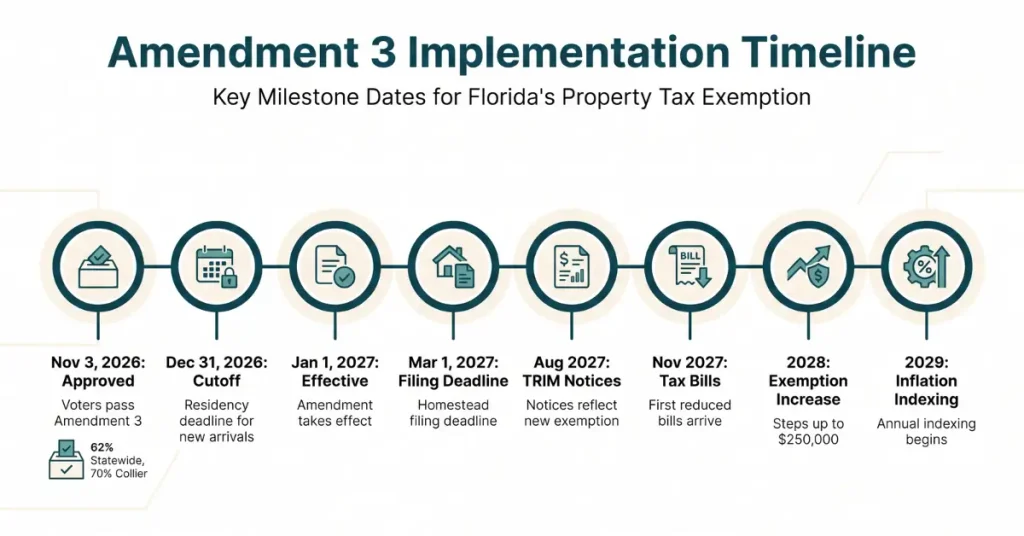
Voters approved Amendment 3 on Nov. 3, 2026, clearing the 60% needed. Statewide, about 62% voted yes, and Collier County voted 70% yes. Treat the figures as unofficial until certified.
Florida Realtors backed the measure with a Vote Yes on 3 campaign.
Here’s the timeline for Collier County homeowners:
- Nov. 3, 2026: Voters approved the amendment (unofficial until certified).
- Dec. 31, 2026: The residency cutoff for new arrivals.
- Jan. 1, 2027: The amendment takes effect.
- March 1, 2027: Homestead filing deadline for owners who own the home on Jan. 1.
- August 2027: TRIM notices first show the new exemption.
- November 2027: The first tax bills with the change arrive.
- 2028: The exemption steps up to $250,000.
- 2029: Inflation indexing begins.
What Happens Next After Voters Approved Amendment 3?
The amendment takes effect Jan. 1, 2027. It raises the non-school homestead exemption, cuts the non-homestead cap to 5% and limits how counties and cities spend property tax revenue. Naples homeowners will see the first change on August 2027 TRIM notices. Until the results are certified, treat the numbers as unofficial.
The Save Our Homes cap and portability stay in place. Today’s exemption of up to $51,411 and the 10% cap on second homes apply through the end of 2026.
How Does the Homestead Exemption Change a Naples Tax Bill?
The non-school homestead exemption grows from $51,411 today to $150,000 in 2027 and $250,000 in 2028. School taxes keep the old $25,000 exemption.
Non-school taxable value after the homestead exemption:
| Assessed value | Today | 2027 | 2028 |
|---|---|---|---|
| $400,000 | $348,589 | $250,000 | $150,000 |
| $750,000 | $698,589 | $600,000 | $500,000 |
| $1,500,000 | $1,448,589 | $1,350,000 | $1,250,000 |
To find your bill, you’ll multiply the taxable value by your millage rate and divide by 1,000. A $400,000 home loses more than half its non-school taxable value by 2028. A $1.5 million home loses about 14%. The flat dollar amount helps smaller homes most.
Long-time owners hold assessed values below market because of the Save Our Homes cap. Use your assessed value from the Collier County Property Appraiser, not your sale price, to get your own figures.
FLE runs the math when it prices a Naples listing.
How Much Could a Naples Homeowner Save?
At an illustrative non-school rate of 10 mills, a $400,000 homestead would save about $986 in 2027 and about $1,986 in 2028. Its non-school taxable value drops from $348,589 to $250,000, then to $150,000. Your real millage depends on your city, fire district and other taxing districts, so use the rate printed on your own tax bill.
What Does the 5% Cap Mean for Second Homes in Naples?
The 5% cap limits yearly assessed value growth on second homes, rentals, and commercial property. The old limit was 10%. The change starts Jan. 1, 2027, and leaves school taxes alone. The cap also covers vacation homes and apartment buildings. Investors in Bonita Springs and Estero should plan around it.
A cap on value isn’t a cap on rates. Collier County still sets the tax rate each year. Seasonal owners in Vanderbilt Beach and Marco Island see slower value growth, not a lower rate.
The Florida Policy Institute calls the amendment a tax shift, not a savings. Rental owners investing in Southwest Florida can price the cap into their returns.
Does Amendment 3 Mean Florida Property Tax Elimination?
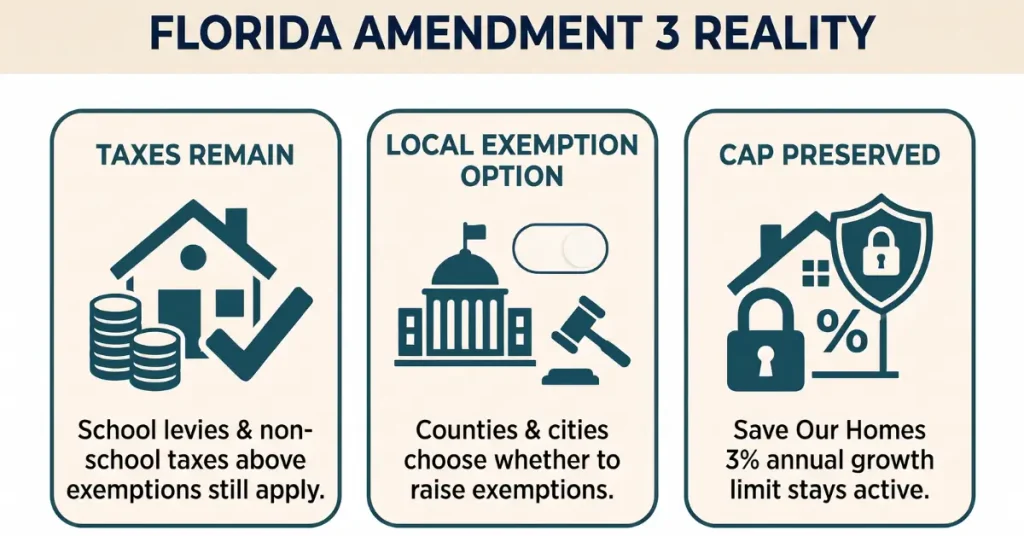
No, Amendment 3 leaves a tax bill in place. Homeowners still pay non-school taxes on value above the exemption, and school levies stay the same.
The ballot text tells the Florida Legislature to set one procedure. Counties and cities can then raise the exemption up to full assessed value. Special districts need voter approval to do the same. The Save Our Homes cap, a 3% (or CPI, if lower) yearly limit on homestead value growth, stays in place.
The amendment steers county and city property tax money toward public safety, schools, infrastructure, natural resources, debt, retirement benefits, and operations. Non-ad valorem assessments on your bill are not reduced by the homestead exemption. FLE can walk Naples clients through these limits before a listing goes live.
What Does Amendment 3 Mean for Naples Home Buyers and Sellers?
Buyers qualify for the larger exemption immediately only if they are Florida residents by Dec. 31, 2026. A seller’s tax bill never carries over to the buyer. Newcomers who become Florida residents on or after Jan. 1, 2027 start with a $50,000 non-school exemption. The larger amount starts in their fifth year of exemption.
Owners who own the home on Jan. 1 must file by March 1 to meet the homestead filing deadline. Ask your lender how it sets escrow, and ask your agent which exemption applies to you.
A sale resets the home’s assessment to market value, so a seller’s tax figure never matches the buyer’s bill. Sellers should price against the latest Southwest Florida market update. The buyer’s own exemption sets the final bill. FLE can help Naples sellers handle the tax-bill conversation with buyers.
How Does Amendment 3 Affect Collier County Budgets?
Local governments lose property tax revenue now that voters approved the amendment, and published estimates put numbers on it. Reported estimates show Collier County government losing about $47.7 million in fiscal 2027-28, rising to $134.2 million by fiscal 2031-32. Property taxes make up about 64% of the county general fund.
Cities feel it too. The same report estimates Naples losing about $1.5 million in fiscal 2028 and $2.3 million in 2029, while Marco Island faces $1.07 million in fiscal 2027-28 and $3.4 million by fiscal 2031-32. Collier fire districts project an $18 million deficit for fiscal 2028 and more than $34 million the following year.
Statewide, the Florida Policy Institute estimates the cut at roughly $12 billion in local revenue on a recurring basis.
Florida Listing Experts LLC lists homes in Naples. Tax rates and fees affect what buyers pay each year, so check local budget notices before you price.
Florida Property Tax Amendment FAQs
Does Amendment 3 Change School Taxes?
No. The old $25,000 school exemption stays, and the new amounts cover non-school levies only. School districts still tax the rest of your assessed value at their own millage rate, so your bill keeps a school portion. Compare both lines on your TRIM notice.
When Does the Florida Property Tax Amendment Take Effect?
The start date is Jan. 1, 2027. Voters approved it on Nov. 3 with about 62% in unofficial returns. Owners will first see the change on August 2027 TRIM notices and November 2027 tax bills.
What If I Just Moved to Florida?
Owners who were not Florida residents on Dec. 31, 2026 start with a $50,000 non-school exemption. The larger amount starts in the fifth year of exemption.
Does the Amendment Cover Condos in Naples?
Yes. The measure applies to owner-occupied homes and condos that hold a homestead exemption. The condo must be your permanent residence on Jan. 1, and you must file for homestead by March 1. Association fees and reserve requirements are separate, and the amendment does not change them.
Does Amendment 3 Help Second-Home Owners?
Vacation properties don’t earn the homestead exemption. Rental and second-home assessments grow by 5% a year at most instead of 10%. The lower cap applies only to non-school value, and local millage rates can still change each year, so a capped value does not guarantee a lower bill.
Does the Save Our Homes Cap Change?
No. The 3% limit on homestead value growth stays. Increases remain limited to 3% or the CPI change, whichever is lower. Portability still lets you move your Save Our Homes benefit to a new Florida homestead.
Can Florida Listing Experts Help Me Sell in Naples?
Yes. FLE lists homes across Collier County and runs your numbers before you price. The FLE team can review your assessed value and exemption status when setting a list price. Contact us to schedule a free consultation. Call (239) 919-0933.
What Should You Do Now That Amendment 3 Passed?
Confirm your March 1, 2027 homestead filing and your Dec. 31, 2026 residency date, because the Florida property tax amendment changes your bill and your listing plan. Pull your assessed value from the Collier County Property Appraiser, find your millage rate on your tax bill, multiply, and divide by 1,000.
Florida Listing Experts LLC is not a tax advisor, so confirm final figures with the Collier County Tax Collector. Florida Listing Experts LLC can also run a free home valuation and walk you through what the amendment means for your sale or purchase. Ready to list or buy in Naples? Contact Florida Listing Experts LLC at (239) 919-0933.