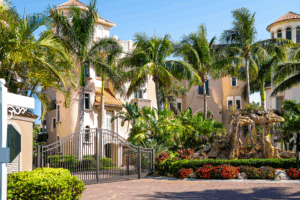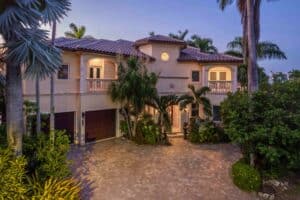

Hurricane-ready homes in SW Florida are built or upgraded to stay sealed when a storm hits, and buyers here now check for that before they check the floor plan. Impact windows, a strapped roof, concrete block or ICF walls, a rated garage door, and elevation above the flood line separate a house that rides out a Category 4 from one that does not. This guide walks through each feature, what the Florida Building Code requires, how wind mitigation credits lower your insurance bill, and which retrofits are worth the money on an older property. Florida Listing Experts runs the same checklist on every showing across Naples, Marco Island, Bonita Springs, Estero, Fort Myers, and Cape Coral.
Key Takeaways
- Hurricane-ready homes in SW Florida are built or retrofitted to resist high wind, flying debris, water intrusion, and storm surge.
- The Florida Building Code sets the minimum standard. Homes permitted after 2002, and again after the 2020 code update, generally perform better than older homes.
- The five features that matter most are impact-rated windows and doors, a reinforced roof system, concrete block or ICF walls, a rated garage door, and elevation above base flood elevation.
- Florida Statute 627.711 requires insurers to offer premium discounts for verified wind mitigation features. A wind mitigation inspection documents them.
- Older homes can be retrofitted. Impact glass, hurricane straps, roof re-nailing, and a reinforced garage door deliver the largest return.
- Florida Listing Experts tours hurricane-ready homes across Naples, Marco Island, Bonita Springs, Estero, Fort Myers, and Cape Coral.
Why Hurricane-Ready Homes in SW Florida Are Now the Default Search
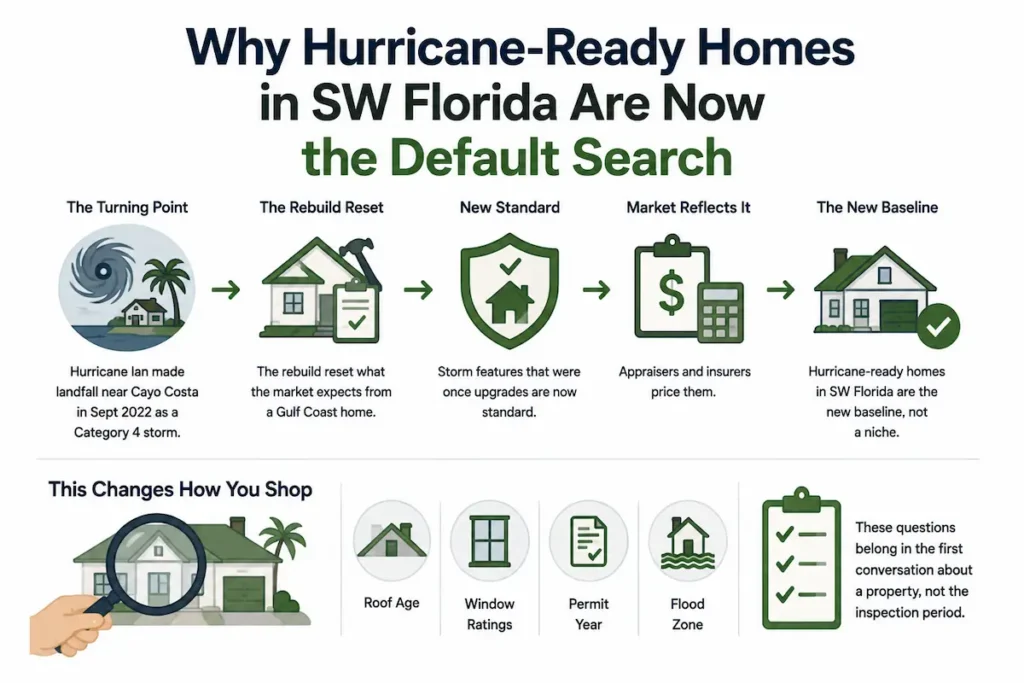
The shift is permanent, and it has a clear starting point. Hurricane Ian made landfall near Cayo Costa in September 2022 as a Category 4 storm, and the rebuild that followed reset what the market expects from a house on the Gulf Coast. Builders that once listed storm features as upgrades now list them as standard. Appraisers and insurers price them. Consequently, hurricane-ready homes in SW Florida are no longer a niche listing category. They are the baseline.
That changes how you shop. Roof age, window ratings, permit year, and flood zone now belong in the first conversation about a property, not the inspection period. The sections below take those questions in order, so you can evaluate any listing with the same checklist a wind mitigation inspector uses.
What Makes a Home Hurricane-Resistant?
The phrase “hurricane proof” is shorthand. No structure is immune to a Category 5 storm. However, engineering reduces the failure points that cause most damage. Wind does not usually knock a Florida house down. Wind finds an opening, pressurizes the interior, and lifts the roof off. Therefore, a hurricane-resistant home is one where the building envelope stays sealed.
That envelope is protected by five systems working together.
Impact Windows and Doors
Impact-resistant glass uses a laminated interlayer bonded between two panes. Debris cracks the glass, yet the interlayer holds the opening closed. Impact-rated products are tested against a large missile impact followed by thousands of pressure cycles. Hurricane shutters achieve a similar result at lower cost, though they require you to be home to deploy them.
Reinforced Roofing Systems
The roof is the most common point of failure. A strong roof system combines hurricane straps or clips tying each truss to the wall, a secondary water barrier under the shingle or tile, and a nailing pattern that resists uplift. Roof shape matters too. A hip roof sheds wind pressure better than a gable roof.
Concrete Block, Rebar, and ICF Construction
Most Florida homes use concrete block with rebar and poured cells, which resists both wind load and flying debris far better than wood framing. Insulated concrete forms, known as ICF, go further. ICF walls stack foam forms filled with reinforced concrete, and they add energy efficiency along with structural integrity. Deltec Homes and other engineered manufacturers rate certain models for 150 mph winds and above.
Garage Doors
A failed garage door is one of the fastest paths to a lost roof. Once the door blows in, interior pressure spikes and pushes upward and outward. An impact-rated, wind-braced garage door is inexpensive protection relative to what it prevents.
Elevation and Storm Surge Protection
Wind is only half the story. Surge and flooding cause much of the loss. Homes built above the base flood elevation for their FEMA flood zone stay dry when neighboring properties do not. You can check any address against the current maps at the FEMA Flood Map Service Center.
Hurricane-Ready Home Features at a Glance
| Feature | What It Protects Against | Standard or Reference | Wind Mitigation Credit |
|---|---|---|---|
| Impact-rated windows and doors | Flying debris, pressure change, water intrusion | ASTM E1886 / E1996 large missile test | Yes |
| Hurricane shutters (accordion, roll-down, panel) | Flying debris on non-impact glass | Florida Building Code opening protection | Yes |
| Hurricane straps and clips | Roof uplift, truss separation | Roof-to-wall attachment rating | Yes |
| Roof deck re-nailing and secondary water barrier | Deck loss, water entry after shingle loss | Roof deck attachment rating | Yes |
| Hip roof geometry | Concentrated wind pressure at gable ends | Roof shape rating | Yes |
| Concrete block or ICF walls | High wind load, debris penetration | Florida Building Code, Chapter 16 | Indirectly |
| Impact-rated garage door | Envelope breach and internal pressurization | Wind pressure rating on door label | Yes |
| Elevation above base flood elevation | Storm surge, flooding | FEMA flood zone, elevation certificate | Flood policy, not wind |
| Whole-home generator | Post-storm power loss | Not structural | No |
Bring this table to a showing. Ask the listing agent to confirm each row. Whatever a seller cannot confirm, a wind mitigation inspector can.
Florida Building Codes for Hurricane Protection
Florida rewrote its building code after Hurricane Andrew, and the statewide code took effect in 2002. Since then, the code has been updated on a roughly three-year cycle by the Florida Building Commission. Collier County and Lee County both sit in a high-velocity wind zone, so design wind speeds and opening protection requirements are stricter here than in inland counties.
Two dates matter when you evaluate a listing. A home permitted after 2002 was built under the modern code. A home permitted after the 2020 code cycle meets tighter requirements still. Consequently, permit year is often more predictive of storm performance than the year the house appears in tax records. You can verify current code editions through the Florida Building Commission.
Beyond code minimums, the IBHS FORTIFIED standard offers a third-party designation for roofs and whole homes. FORTIFIED Roof is the most attainable level for existing homes and is recognized by many carriers.
Do Hurricane-Resistant Homes Lower Insurance Costs?
Yes. Florida Statute 627.711 requires residential property insurers to provide premium discounts, credits, or rate differentials for construction techniques that reduce wind loss. The savings are documented through a uniform mitigation verification inspection, commonly called a wind mitigation inspection, performed by a licensed inspector.
The credit amount varies by carrier and by which features your home has. Nevertheless, the process is consistent: the inspector records roof covering, roof deck attachment, roof-to-wall connection, roof geometry, secondary water resistance, and opening protection. Each category maps to a credit. Buyers who order this inspection during the due diligence window know their true carrying cost before closing rather than after.
Flood coverage is separate. Wind credits do not reduce flood premiums, and flood premiums are driven by elevation and FEMA flood zone. Owners who are relocating to Southwest Florida from states without a flood market are often surprised by this split, so budget for both lines.
Are There Hurricane-Proof Communities in Florida?
Whole-community resilience is a real design category. Babcock Ranch, north of Fort Myers, is the most cited example. It was master planned with buried utilities, a solar array, and elevated stormwater management, and it retained power and stayed largely intact through Hurricane Ian.
Closer to Naples, resilience shows up at the neighborhood level rather than the town level. Newer gated communities built after 2015 tend to carry consistent construction standards across every home, which removes the guesswork of buying in a mixed-age neighborhood. If you want to compare build eras and elevations by area, start with the top communities in Southwest Florida and narrow from there.
Waterfront buyers face a different math. Direct Gulf access is a premium asset, yet it usually comes with a lower elevation and a higher surge exposure. Buyers looking at Naples homes with boat docks should review the elevation certificate and the seawall condition alongside the dock specs.
How to Make an Older Home Hurricane-Ready in Florida
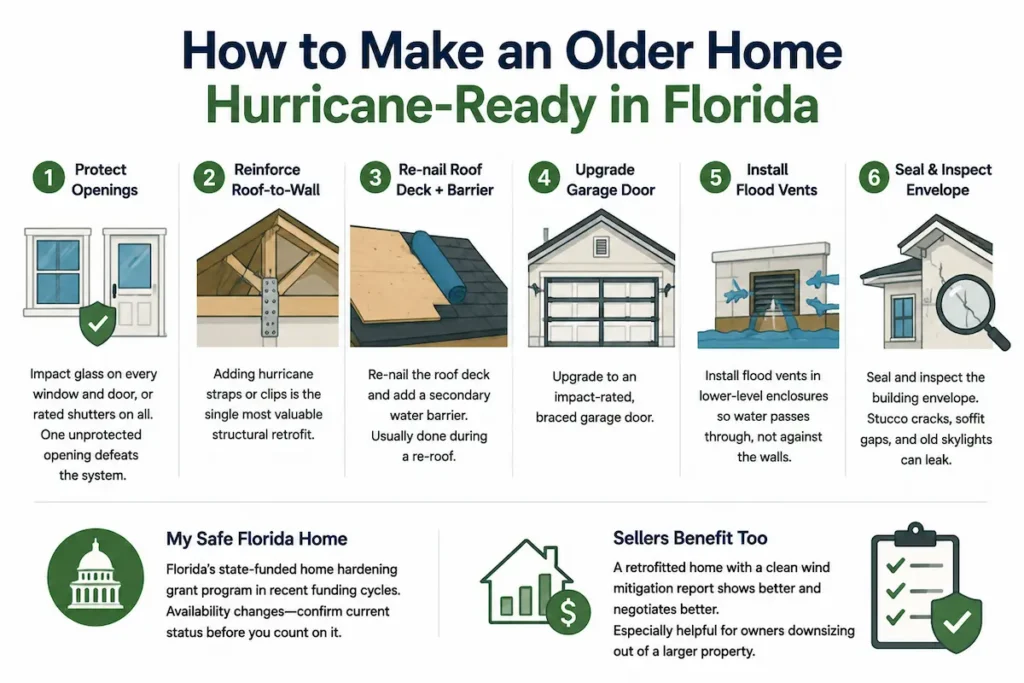
Plenty of great Southwest Florida homes predate the modern code. Charm and location do not have to mean exposure. Retrofits, ranked by impact per dollar:
- Replace or protect the openings. Impact glass on every window and door, or rated shutters on all of them. Partial protection does not work, because one unprotected opening defeats the system.
- Reinforce the roof-to-wall connection. Adding hurricane straps or clips is the single most valuable structural retrofit for a wood-truss home.
- Re-nail the roof deck and add a secondary water barrier. Usually done during a re-roof, so time it with the roof replacement.
- Upgrade the garage door to an impact-rated, braced unit.
- Install flood vents in lower-level enclosures so rising water passes through instead of pushing against walls.
- Seal and inspect the building envelope. Stucco cracks, soffit gaps, and old skylights are common water intrusion paths.
Florida has run a state-funded home hardening grant program, My Safe Florida Home, in recent funding cycles. Availability changes by legislative session, so confirm current status before you count on it.
Sellers benefit too. A retrofitted home with a clean wind mitigation report shows better and negotiates better. This matters especially for owners downsizing out of a larger property, where a documented roof and opening upgrade often closes the gap between asking and offer.
Where to Find Hurricane-Ready Homes in SW Florida
Inventory and price behave differently across the region.
- Naples. Deep new construction inventory in the eastern corridor with consistent post-2015 standards. Older coastal Naples requires closer inspection.
- Marco Island. Low elevation and high exposure, so elevation certificates and seawall condition carry unusual weight. Newer rebuilds here are often built well above the minimum.
- Bonita Springs and Estero. Strong middle ground. A lot of post-2002 stock, plus newer gated communities with uniform build quality.
- Fort Myers and Cape Coral. The largest supply of hurricane-proof renovations, since the post-Ian rebuild cycle updated thousands of roofs and windows. Verify permits closed properly.
Each market trades elevation against water access. Understanding why buyers choose Southwest Florida helps clarify which tradeoff fits your plan.
Why Work With Florida Listing Experts
Florida Listing Experts screens for storm performance during the search, not after the inspection period opens. We pull permit history, check the flood zone and base flood elevation, note the roof age and covering, and flag which openings are impact rated. For buyers moving in from out of state, our relocation services coordinate that review with the timing of a long-distance move.
Broker and Owner Nella Christina DeCesare leads the team from the Naples office at 2260 Randall Blvd., serving Collier and Lee counties. Appointments are scheduled in advance.
Bringing It All Together
Storm readiness is a measurable property attribute, not a marketing phrase. Permit year, roof-to-wall connection, opening protection, wall construction, and elevation tell you how a house will perform, and a wind mitigation report puts numbers behind the answer. Buyers who evaluate hurricane-ready homes in SW Florida with that checklist pay less for insurance, face less repair risk, and hold an asset the next buyer will also want.
Call Florida Listing Experts at (239) 919-0933 or get in touch for a free estimate Florida Listing Experts to tour hurricane-ready homes across Naples, Marco Island, Bonita Springs, Estero, Fort Myers, and Cape Coral.
Frequently Asked Questions
What makes a home hurricane-resistant in Florida?
A hurricane-resistant home keeps its building envelope sealed. That requires impact-rated windows and doors or rated shutters, a roof deck properly nailed and strapped to the walls, concrete block or ICF construction, an impact-rated garage door, and elevation above the base flood elevation for its FEMA flood zone.
Are there hurricane-proof homes for sale in Florida?
Yes, though the accurate term is hurricane resistant. Homes permitted after the 2002 Florida Building Code, and especially after the 2020 code cycle, meet modern wind standards. Listings in Naples, Fort Myers, and Cape Coral frequently advertise impact glass, reinforced roofs, and elevated slabs as primary features.
What kind of house can withstand a Category 5 hurricane?
Reinforced concrete or ICF construction with a hip roof, impact-rated openings, and a rated garage door performs best against Category 5 wind on the Saffir-Simpson scale. Some engineered homes are rated above 190 mph. Surge exposure still depends on elevation rather than wall strength.
How much does hurricane-resistant construction cost in Florida?
Cost depends on square footage, wall system, and how many openings need protection. Impact glass typically costs more than shutters. ICF costs more than block, yet reduces energy use over time. Get itemized quotes, since wind mitigation credits offset part of the expense annually.
Do hurricane-resistant homes lower insurance premiums?
Yes. Florida Statute 627.711 requires insurers to offer credits for verified wind mitigation features. A licensed inspector completes a uniform mitigation verification form covering roof covering, deck attachment, roof-to-wall connection, roof geometry, secondary water resistance, and opening protection. Flood premiums are separate and driven by elevation.
Where is the safest place to live in Florida from hurricanes?
Inland, elevated locations face less storm surge risk than coastal barrier islands. Within Southwest Florida, eastern Collier County and inland Lee County sit at higher elevation than Marco Island or coastal Cape Coral. Construction quality and elevation matter more than distance from the coast alone.
Can an older Florida home be made hurricane ready?
Yes. Retrofitting works. Prioritize opening protection first, then roof-to-wall straps, roof deck re-nailing with a secondary water barrier, an impact-rated garage door, and flood vents in lower enclosures. These upgrades qualify for wind mitigation credits and improve resale value.
What is ICF construction and is it better than concrete block?
Insulated concrete forms are stacked foam forms filled with steel-reinforced concrete. ICF delivers high wind and debris resistance plus continuous insulation, so it outperforms standard block on energy efficiency. Concrete block with filled, reinforced cells remains the Southwest Florida standard and performs well under current code.
How do I check a home’s flood zone before buying?
Enter the property address at the FEMA Flood Map Service Center to view the effective flood map. Then request the elevation certificate from the seller or county. The certificate shows finished floor elevation relative to base flood elevation, which drives flood insurance pricing.
Do impact windows replace hurricane shutters?
Impact windows provide permanent protection without deployment, so they satisfy opening protection requirements on their own. Shutters cost less and protect existing non-impact glass. Mixing them is acceptable if every opening is covered, because one unprotected opening allows internal pressurization.